
1 min read
Thank Goodness We Decided That Openness Is The Way Forward
Updated 12 February 2026 Having an end-to-end digital solution for planning and executing drilling and well...
3 min read

Updated 12 February 2026
Wondering how to optimize your approach to the huge amount of data and actors in drilling and well operations? Finding too many options and services for how to interact, store and transfer your project’s data?
In drilling and well operations, the volume of data, systems and stakeholders continues to grow. With dozens of applications, vendors and workflows involved across the well lifecycle, operators increasingly struggle with how to store, transfer and actually use their data in an efficient and scalable way.
This article explains what an open data platform is, why it matters, and how it supports digitalization across the drilling and wells domain.

Today’s software ecosystem includes countless data structures, transfer protocols and encryption schemes. In oil and gas, many of these are bespoke, built for specific tools or workflows, and rarely compatible with each other. APIs exist, but not all are open or standardized.
An open data platform refers to a system designed so that data can be accessed, transferred and used through non-proprietary, standardized interfaces.
In simple terms, an open data platform allows you to:
Use your data freely, beyond the vendor’s main application
Move data in and out without restrictions or lock-in
Integrate with other tools, analytics or cloud services
Retain ownership and control over how and where data is used
Importantly, “open” does not mean unsecured or publicly accessible. Security exists at a different layer: identity management, access control, authentication and encryption.
Open simply means your data is not trapped, making it far more useful across operations and disciplines.
Additional reading: Breaking down silos: From SharePoint to integrated software platforms
Drilling and well operations are unusually complex, involving a wide range of disciplines:
Well engineering
Geoscience and seismic interpretation
Risk and regulatory compliance
Logistics
Vendor operations and service companies
Real-time data centers
Reporting and analytics
Traditionally, data has flowed manually across silos — files, screenshots, exports, emails, and re-entry into different applications. This slows the entire operation and introduces risk.
With closed platforms, data becomes locked to a specific system or vendor. For example:
Wireline logs may be accessible only inside the wireline software
Operational data cannot easily be shared with logistics or budgeting
Analytics tools cannot pull data without custom integrations
This reduces flexibility, creates vendor dependency, and makes collaboration unnecessarily difficult.
With an open platform, data can serve multiple purposes across multiple workflows — without friction.
Closed platforms create scalability and sustainability challenges:
Integrations become expensive and slow
Backwards compatibility suffers
Moving to new systems becomes difficult
Cross-disciplinary workflows break down
A simple analogy:
Imagine an office building where every document must be physically trimmed to fit proprietary filing cabinets. Once stored, only the vendor’s own tools can access them. If you move to a new building, you must remodel every cabinet or pay someone to “unlock” your own files.
That’s the burden of a closed data platform.
An open platform gives you the ability to choose, and change, your own filing cabinets, locks and access rules. It strengthens data ownership while increasing operational flexibility.
Read more: Challenges (and rewards) of embracing a Digital Collaboration Platform
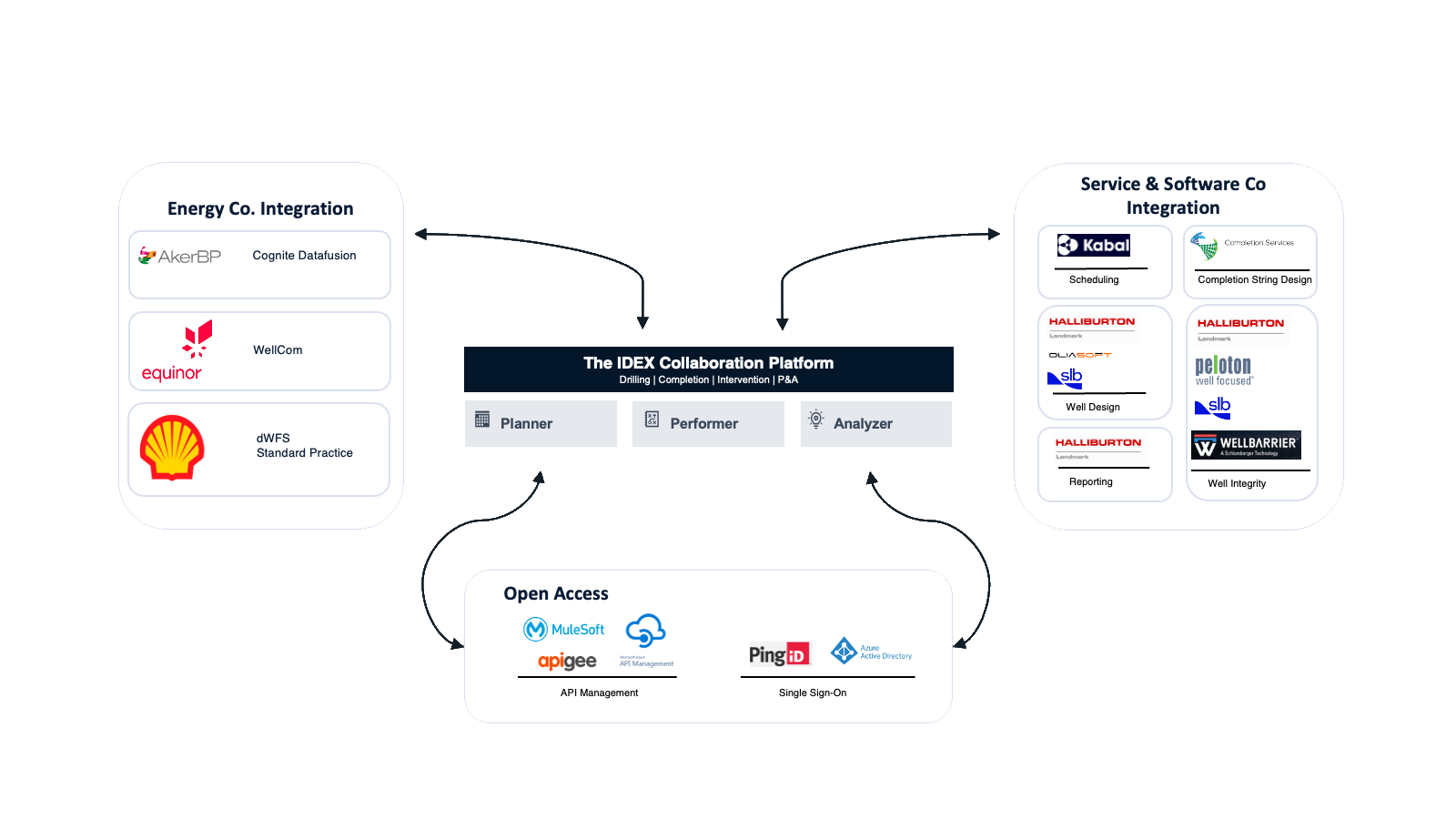
Open APIs and industry standards, such as REST APIs and WITSML, enable secure, structured communication between systems while preserving data integrity.
Open does not mean unprotected. Robust platforms still include:
Advanced encryption
Multi-factor authentication
Role-based access control
Complete audit trails
With this foundation, organizations can give targeted access to specific datasets, integrate advanced analytics (PowerBI, cloud AI, etc.), and unlock much richer data-driven workflows.
An open data platform uses non-proprietary methods to store, access and transfer data, giving operators far more flexibility in how that data is used across drilling and well operations.
It supports:
Scalability
Backwards compatibility
Future technology adoption
Cross-domain collaboration
Data ownership and security
As digitalization accelerates, choosing an open platform is increasingly a strategic decision, one that determines how effectively your organization can scale, innovate and collaborate in the years ahead.
1 min read
Updated 12 February 2026 Having an end-to-end digital solution for planning and executing drilling and well...

1 min read
Updated 12 February 2026 Do you remember the shift from storing documents on a shared network drive to collaborating...

1 min read
Updated 12 February 2026 Full autonomy is often seen as the “holy grail” for industrial operations, and oilfield...