
1 min read
AI – How Can It Help Planning and Executing Well Intervention Jobs?
Updated 12 February 2026 There’s no doubt that there is a real buzz about AI, and have been for some time. Which...
3 min read
Updated 12 February 2026
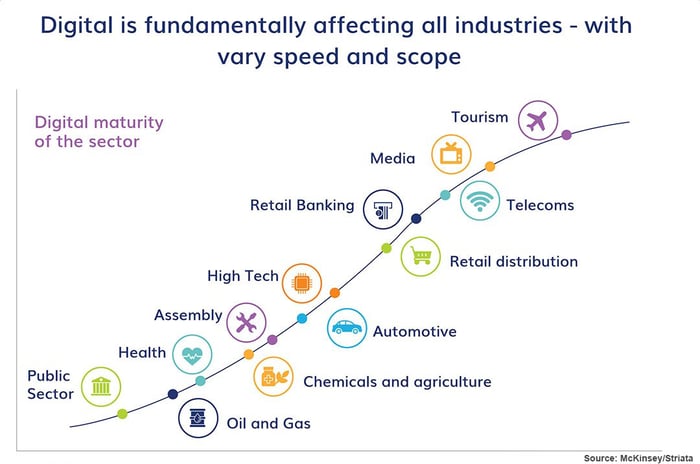
The idea of a fully digital well, where data flows seamlessly across planning, execution and post-job learning, has long been a vision for the oil and gas industry. Yet the gap between ambition and reality remains significant. As early as 2016, McKinsey Digital highlighted oil and gas as one of the least digitized industries in the global economy. Nearly a decade later, progress is visible, but the overall digital maturity of the sector still trails other industries by a wide margin.
The challenges are not new: inconsistent operational performance, organizational misalignment, fragmented data ecosystems, and low readiness for digital transformation. But the opportunities are greater than ever. New technologies, modern collaboration platforms and AI-driven analytics are reshaping what is possible, if companies are ready to adopt them.
This article outlines the key challenges, industry insights and practical pathways toward achieving the vision of One Digital Well.

In a 2024 interview, Molly Smith, VP of Drilling and Completions at Murphy Oil, summarized the industry’s path forward:
“I think there are three things the industry needs to focus on with data;
First, standardization needs to improve so that we can reduce the time we spend engineering data and increase the time we spend analyzing data.
Second, we need to invest in innovating machine learning and artificial intelligence methods so that they can fit with more industry-centric datasets and workflows.
And third, we must improve the efficacy of our data-modeling methods so that they can give us a more comprehensive understanding of our operations.”
This perspective captures three of the largest barriers to digital adoption:
Poor data standardization
Limited support for oilfield-specific AI/ML workflows
Fragmented data models that weaken operational understanding
At Stimline Digital, we share this view. Tools like the IDEX Collaboration Platform, already used by Shell to standardize global well operations, give engineering teams more time to analyze, optimize and deliver higher performance rather than manipulating data manually.
Read more: Thank Goodness We Decided That Openness Is The Way Forward
Market uncertainty continues to pressure operators to become more efficient. Digitalization and automation are no longer “innovation projects”, they are fundamental levers of competitiveness.
Climbing the digitalization ladder offers clear advantages:
Lower cost per well
Faster diagnostics
Higher operational consistency
Stronger decision-making driven by real-time data
However, McKinsey’s research shows that 70% of digitalization initiatives never move beyond the pilot phase. The issue is rarely technology. The barriers are human, organizational and structural.
Read more: New methods of post job analysis (traditional vs new)
Surprisingly, the issue isn't usually the technology itself. Many pilot projects succeed, meeting or surpassing their technical goals. The real issue lies in three significant cultural and organizational barriers.
1. Unclear or Missing Value
Digital initiatives fail when they do not address the true operational bottlenecks. If a use case cannot demonstrate measurable bottom-line impact, scaling becomes difficult—no matter how innovative the technology is.
2. Workforce Resistance and Skill Gaps
Employees are asked to adopt new tools, change familiar workflows and develop new competencies. Without clear incentives and strong operational support, resistance is inevitable.
3. Treating Digitalization as a “Project,” Not a System
Many companies run isolated pilots in parallel with legacy systems. When the pilot ends, workflows revert.
For digitalization to scale sustainably, it must be integrated into:
Organizational structures
Operational timelines
Existing software landscapes
Standard planning and execution processes
The IDEX Collaboration Platform is designed specifically to overcome these barriers. It is:
Open – integrating easily with third-party or in-house systems
Flexible – supporting real-world workflows across planning, execution and reporting
Scalable – built for enterprise-wide adoption, not isolated pilots
Contextual – aligning data, decisions and accountability across the well lifecycle
IDEX provides the transparency and consistency needed to move from fragmented digital efforts to a unified, end-to-end operational ecosystem, the foundation of One Digital Well.
The journey toward a fully digital well is far from complete, but the industry is moving in the right direction. With the right tools and frameworks, like the IDEX Collaboration Platform, operators can unlock:
Higher productivity
More meaningful use of data
Stronger collaboration between teams
Faster learning loops and continuous improvement
Digitalization is no longer a vision of the future; it is a requirement for operational excellence today. Those who embrace it will shape the next era of well operations.

1 min read
Updated 12 February 2026 There’s no doubt that there is a real buzz about AI, and have been for some time. Which...

1 min read
 Tom Fedog : Apr 7, 2022, 9:00:00 AM
Updated 12 February 2026 Digitalization is an ongoing trend, affecting all industries including the energy industry....
1 min read
Updated 12 February 2026 Drilling and well operations are becoming increasingly digital, yet many teams still rely...